You Don’t Have to Offer Every Service: A Beautypreneur’s Guide to Saying No
You Don’t Have to Offer Every Service: A Beautypreneur’s Guide to Saying No
Why narrowing your menu, developing your style, and learning to say no can actually make your beauty business stronger.
When you’re starting a beauty business, saying yes can feel like the safest thing to do.
Yes, I can do that.
Yes, I can add that service.
Yes, I can learn that technique.
Yes, I can recreate that design.
Because when you’re trying to build a clientele and make money, the idea of turning someone away can feel terrifying. You don’t want to miss out on a booking simply because you don’t offer what they’re asking for.
But after more than a decade of running my own beauty business, I’ve learned something that took me years to understand:
You don’t have to offer every service.
In fact, learning what not to offer can be one of the most important parts of building a business that actually feels like yours.
1. More services don’t necessarily mean more money
When you’re new, it’s easy to think that a bigger service menu automatically means more opportunities.
If I offer gel, acrylic, tips, sculpting, every type of nail art, pedicures, and everything in between, surely I’ll attract more clients — right?
Not necessarily.
Every service you add requires time, education, products, equipment, maintenance, and mental energy. And if you don’t particularly enjoy doing that service, you’re also building a part of your business around something you don’t actually want to be known for.
There’s a difference between being capable of doing something and wanting to build your business around it.
I learned this very early in my career.
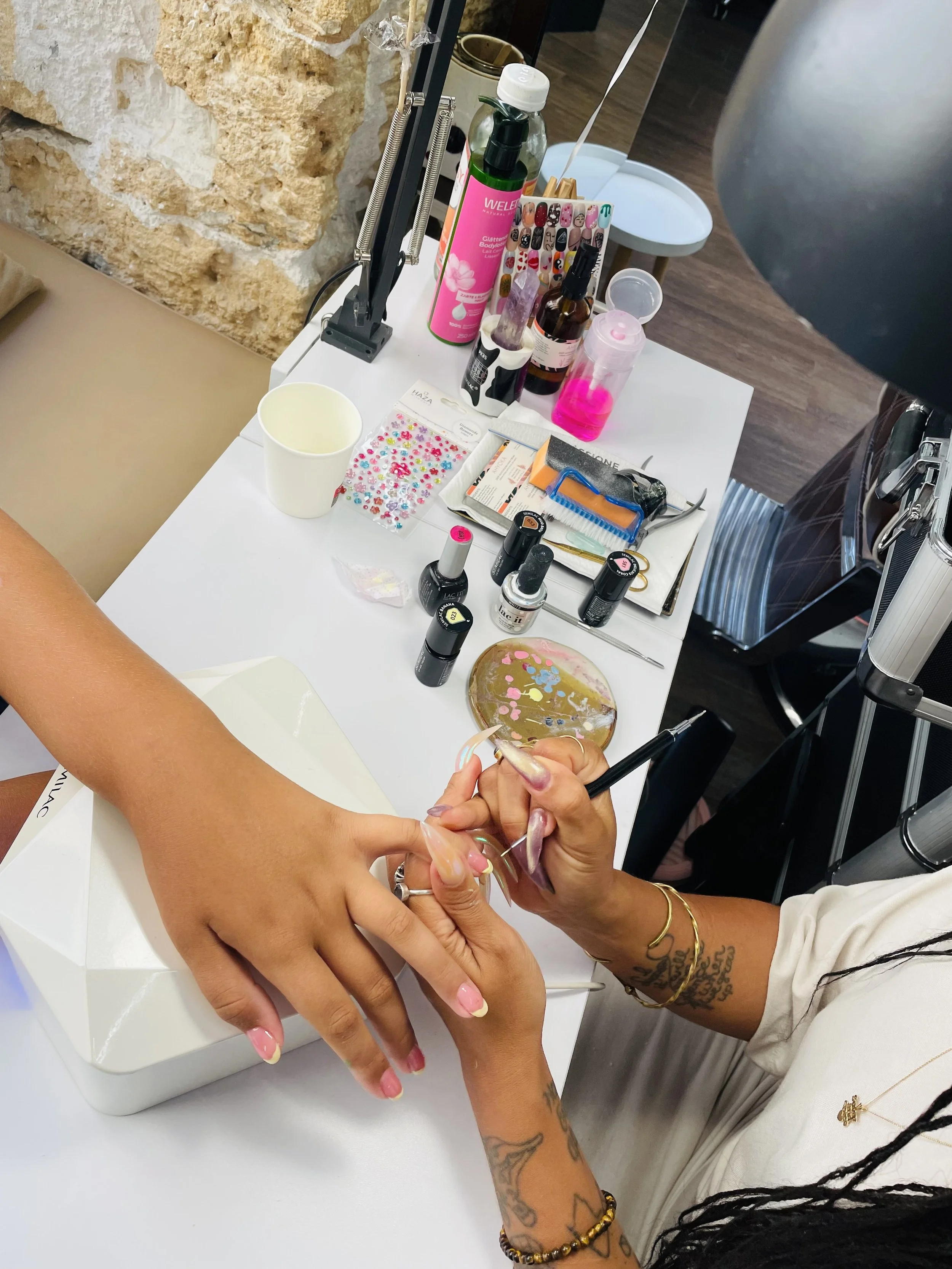
2. Your service menu should reflect your style
When I went to private nail school in Canada, I learned how to use gel, sculpt extensions and work with tips. I didn’t learn acrylic, and initially I remember thinking, Should I be offering that too?
I decided that I wanted to focus on sculpted extensions instead of plastic tips because I preferred the technique and the finished result. I also wanted my business to align more closely with my interest in environmentally conscious practices and the products I chose to use.
But then I did what so many new beautypreneurs do.
I thought, Maybe I should offer acrylic too. I’ll make more money if I can accommodate people who want it.
So I paid for another private, one-on-one course in Ontario and learned acrylic.
And then I decided I didn’t want to offer it.
The smell wasn’t for me, the products didn’t align with the direction I wanted my business to take, and ultimately, I didn’t feel passionate about building a service around it.
And that’s okay.
I was still grateful I took the course because I learned something new, including techniques that helped me understand different types of nail art.
I’ve always believed that no money is wasted when you spend it on education.
But education doesn’t mean you have to offer everything you’ve learned.
Sometimes learning something is simply how you discover that it isn’t for you.
3. You are allowed to have a style
This becomes especially important with nail art.
There are an almost endless number of nail-art techniques, trends and aesthetics circulating through Instagram, Pinterest and TikTok. New designs appear constantly, and there is always another trend you could learn.
It is impossible to be every kind of Nail Artist.
And I don’t think you should try to be.
Over the years, I’ve developed a very distinct style. I’ve also become much more confident about saying when something isn’t my style.
During busy season, I turn down nail-art requests regularly.
Sometimes a client will send me a Pinterest image and ask me to recreate it. I always explain that I don’t copy another artist’s work. I can use an image as inspiration and create my own interpretation, but I don’t want a client to arrive expecting an exact replica.
The same applies to extensions.
There are many different ways to sculpt and structure extensions. If someone sends me an image of a shape or style that isn’t how I work, I’ll tell them.
Not because I don’t appreciate their reference.
Not because their idea is bad.
Simply because I know what I do well, and I know what I want my work to look like.
If you’re completely set on a particular style that isn’t mine, I would rather be honest and recommend finding a Nail Artist whose work matches what you’re looking for.
That’s not bad customer service.
That’s transparency.
4. Saying no is a skill
There is a difference between being difficult and being clear.
A difficult response might be:
“I don’t do that.”
A confident professional response is more like:
“That’s not a style I offer, and I don’t think I’d be the right Nail Artist for the look you’re after. I’d rather be transparent with you so you can find someone who specializes in that style.”
You aren’t rejecting the person.
You’re making sure they don’t spend their money expecting one thing and receive something completely different.
And yes, occasionally someone might be disappointed.
That’s part of running a business.
You cannot build a successful business around making every single person happy.
5. Your menu is allowed to evolve with you
Having a specific style doesn’t mean your service menu can never change.
Your business should evolve as your circumstances change.
I learned this after moving my business from Canada to Mallorca.
In Canada, I never offered pedicures. I was making more than enough money focusing on the services people specifically came to me for: my nail art and extensions.
Then I moved to Mallorca.
Suddenly, I was running a nail business in a warm, sunny destination where people actually want their feet done for much more of the year.
My first instinct was still to say no.
But eventually I asked myself a different question:
How much business might I be missing by refusing to adapt?
So I decided to add pedicures — but I didn’t suddenly start offering every type of pedicure.
I chose the type that made sense for my business, my setup and the way I like to work: a waterless Russian pedicure.
There are clients who want a traditional spa pedicure with soaking and scrubbing. That’s perfectly fine. It simply isn’t what I offer.
My service page makes that clear, and the clients who book with me know what they’re getting.
That’s the difference between changing your business to chase every client and evolving your business intentionally.
6. There’s a difference between turning away money and protecting your business
This is probably the hardest lesson to learn when you’re starting out.
Sometimes saying no really does mean turning away money.
But sometimes saying yes costs you more.
It might cost you time.
It might cost you energy.
It might require products you don’t otherwise use.
It might take you away from the services you actually want to grow.
Or it might leave you creating work you’re not proud of.
And as an artist, that last one matters.
I don’t believe beautiful work comes from forcing yourself to create something you have no enthusiasm for.
I’m a Nail Artist, but I’m also a businesswoman and a solopreneur. My creativity is part of the product I’m selling.
If I’m not excited about what I’m creating, the client is unlikely to get the best version of me.
Protecting that isn’t selfish.
It’s part of protecting the business.
7. You don’t have to be everything to everyone
I say all of this from a place of privilege.
I’ve been doing this for more than ten years. I’ve had the time to develop my skills, build a reputation and become confident in my own style.
I remember what it felt like when I didn’t have that confidence.
When you’re starting out, you might genuinely need to say yes more often. You need clients. You need experience. You need to learn what works.
But eventually, something changes.
You stop asking:
“What can I offer so I don’t lose this client?”
And you start asking:
“Does this belong in the business I’m building?”
That’s a very different question.
You don’t need to master every trend.
You don’t need to offer every technique.
You don’t need to accept every design request.
And you certainly don’t need to become every kind of Nail Artist.
Find the work you love. Get exceptionally good at it. Build a business around it.
And when something doesn’t fit, learn to say no — not because you can’t do everything, but because you’ve decided what you want to be known for.
Thanks for reading this months blog!
Peace & Love,
A