What Makes Gel Polish Vegan? The Animal-Derived Ingredients You Might Not Know About
What Makes Gel Polish Vegan? The Animal-Derived Ingredients You Might Not Know About
Vegan and cruelty-free are two terms we hear everywhere in beauty — but they don’t actually mean the same thing. So what makes a gel polish vegan, and what exactly could be hiding in a non-vegan nail product?
When I tell clients that the gel products I use are vegan and cruelty-free, I sometimes get the same question:
“Wait… what isn’t vegan about gel polish?”
It’s a good question.
Most people don’t picture animal products when they think about nail polish. But certain animal-derived ingredients can be used in cosmetics for everything from creating colour and shimmer to adding texture, gloss or conditioning properties.
That doesn’t mean that every non-vegan gel polish contains all of these ingredients — formulations vary considerably, and some of these ingredients are more commonly found in nail treatments or traditional nail products than in modern gel colour. But if you’re interested in choosing vegan beauty products, these are some of the ingredients worth knowing about.
So, what actually makes a gel polish vegan?
In simple terms, a vegan cosmetic product is made without animal-derived ingredients, animal by-products or derivatives.
For example, The Vegan Society’s standards require that products carrying its Vegan Trademark do not involve animal products, by-products or derivatives in the product or its ingredients.
That means a vegan gel polish doesn’t simply need to look natural or contain plant-based ingredients. It needs to avoid ingredients derived from animals altogether.
And some of those ingredients have surprisingly unexpected origins.
Animal-Derived Ingredients Found in Nail Products
🐟 Guanine — for shimmer and pearlescent effects
Guanine, also known as natural pearl essence or CI 75170, can be obtained from fish scales.
It has historically been used in cosmetics to create that beautiful pearlescent, reflective or shimmery effect — particularly in products with a frosted or iridescent finish. The Vegan Society specifically identifies guanine as an animal-derived cosmetic ingredient obtained by processing fish scales, including those from herring and sardines.
Today, there are plenty of alternatives, including mineral or synthetic effect pigments, so a product doesn’t need guanine to achieve a gorgeous shimmer.
In other words: that beautiful sparkle doesn’t have to come from fish.
🐞 Carmine — for red, pink and crimson pigments
This is probably one of the most surprising ones.
Carmine, also listed as CI 75470, is a red pigment made from cochineal insects. The insects are dried and crushed to produce the pigment.
It’s traditionally used to create rich red, pink and crimson shades and can appear in a variety of cosmetic products.
So if you’ve ever wondered how an ingredient that sounds completely innocuous can make a product non-vegan, carmine is a perfect example.
There are synthetic and mineral pigment alternatives that can create vibrant colours without using insect-derived pigment.
🐚 Shellac — a resin produced by insects
Shellac is a natural resin produced by lac insects and has been used in coatings and cosmetic products for its film-forming and glossy properties.
This one is also worth mentioning because there is sometimes confusion around the word “Shellac” in the nail industry. CND SHELLAC™, for example, is a specific branded gel-polish system; the name shouldn’t automatically be interpreted as meaning that every gel product described as “Shellac” contains shellac resin.
For a product to be vegan, however, any actual shellac ingredient would be excluded because it is insect-derived.
🐝 Beeswax and other animal-derived waxes
Beeswax, commonly listed as Cera Alba, comes from honeybees and can be used in cosmetics as a thickening, texturising or conditioning ingredient.
It’s more commonly encountered in certain nail treatments, balms and care products than as a fundamental ingredient in gel colour, but it is still something to be aware of when checking a product’s formulation.
There are plenty of plant-derived and synthetic wax alternatives available, so avoiding beeswax doesn’t mean sacrificing texture or performance.
🐑 Keratin and silk proteins
You may have seen keratin marketed in nail treatments as a strengthening ingredient.
Keratin is an animal protein and can be sourced from materials including animal hair, horns and feathers. The Vegan Society identifies keratin as an animal-derived ingredient used in products including nail hardeners and strengthening treatments.
Silk proteins, meanwhile, are derived from silkworms and may appear in cosmetic formulations designed to provide conditioning or a particular feel to the product.
Again, these ingredients are more relevant to certain nail treatments and strengthening products than to the basic chemistry of every gel colour.
🐄 Oleic acid and tallow — when the source matters
This is where ingredient lists become a little more complicated.
Oleic acid itself isn’t automatically an animal ingredient. It can be derived from plant oils or animal fats.
Tallow, on the other hand, is rendered animal fat.
This is an important distinction because you can’t always determine the origin of an ingredient simply from its name. Some cosmetic ingredients can be chemically identical whether they originated from plants or animals.
That’s why a genuinely vegan claim often relies on the manufacturer being able to verify the source of the ingredients, rather than simply scanning an ingredient list for obvious animal names.
So, is vegan gel polish the same as cruelty-free gel polish?
No — and this is one of the biggest misconceptions in beauty.
The terms describe two different things.
Vegan = what’s in the product
A vegan product does not contain animal-derived ingredients or animal by-products.
Cruelty-free = how the product was tested
Cruelty-free generally refers to whether a product or its ingredients have been tested on animals.
That means a product can be cruelty-free without being vegan.
For example, a brand could formulate a product containing an animal-derived ingredient such as carmine, while not conducting animal testing. The product could therefore be cruelty-free but not vegan. The Vegan Society makes this distinction explicitly.
Ideally, if avoiding animal-derived ingredients and animal testing is important to you, you’re looking for both: vegan and cruelty-free.
But I live in Europe — aren’t cosmetics already cruelty-free?
This is where things get particularly interesting.
In the EU, animal testing for cosmetic products and cosmetic ingredients is prohibited under the EU cosmetics framework, with the testing and marketing bans introduced progressively between 2004 and 2013.
However, the wider regulatory picture is more complicated because some chemicals used in cosmetics can also be subject to other legislation, such as REACH, for purposes unrelated to cosmetic safety. The European Commission explains that this can mean certain substances may still be subject to animal testing requirements under other regulatory frameworks.
So I wouldn’t write the simplistic statement “all cosmetics sold in Europe are automatically cruelty-free.”
And, importantly, EU animal-testing rules don’t make a product vegan. A product can contain an animal-derived ingredient without having been tested on animals.
Why do I choose vegan gel products?
This is actually a question I get quite often.
When I first started working in the nail industry, I was already very aware of vegan and cruelty-free beauty products.
Living in British Columbia, on the west coast of Canada, where being environmentally conscious, health-conscious and mindful of animal welfare is a pretty strong part of the culture. I was surrounded by people who paid attention to what they were putting on their bodies, where products came from and how animals were treated.
So when I started my career, clients were already asking me:
“Are your products vegan?”
“Are they cruelty-free?”
And honestly, it made sense to me.
I’m not vegan myself, but I do believe that it’s worth being conscious about the products we use and the impact our choices can have on animals and the environment. I also personally choose skincare products that aren’t tested on animals.
So using vegan and cruelty-free nail products was something that became part of the way I approached my work from the beginning.
It’s not because I believe everyone needs to be vegan.
It’s simply about giving people a choice.
If someone sitting at my table cares about what goes into the products being used on their nails, I want to be able to tell them exactly what I’m using — and why.
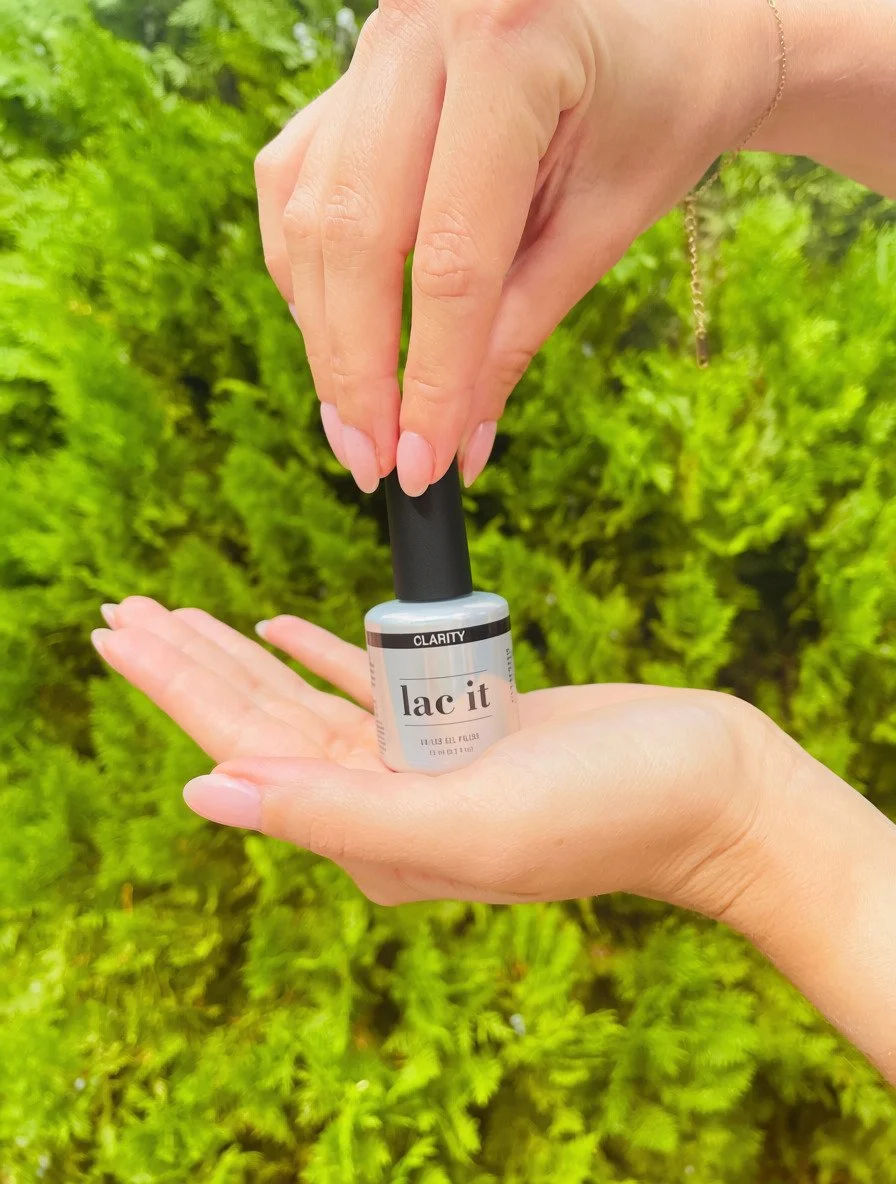
My favourite Canadian gel brand I use that is of course vegan & cruelty free! They are also HEMA-free.
What should you look for when choosing vegan gel polish?
If vegan products are important to you, don’t rely solely on words like “clean,” “natural” or “eco-friendly.” Those terms don’t necessarily tell you whether a product contains animal-derived ingredients.
Instead:
1. Look for a clear vegan claim.
Even better, look for a recognised third-party certification.
2. Check the ingredient list.
Ingredients such as carmine/CI 75470, guanine/CI 75170, shellac, beeswax/Cera Alba and keratin are worth investigating.
3. Remember that ingredient sourcing matters.
Some ingredients — such as certain fatty acids — can come from either plant or animal sources.
4. Ask your nail technician.
If vegan products matter to you, it’s completely reasonable to ask what brands and products your nail technician uses.
And if a brand carries a recognised vegan certification, that’s even easier. The Vegan Society’s Vegan Trademark, for example, involves verification of ingredients and manufacturing standards rather than simply relying on a brand’s own marketing claim.
The bottom line
Vegan gel polish isn’t about sacrificing colour, shine or longevity.
It’s about how the ingredients are sourced.
Animal-derived ingredients have historically been used in cosmetics for very specific purposes — creating pigments, shimmer, gloss, texture or conditioning properties — but modern formulations can use plant-derived, mineral or synthetic alternatives instead.
And perhaps the most important thing to remember is this:
Vegan and cruelty-free are not interchangeable terms.
Vegan tells you about the ingredients.
Cruelty-free tells you about animal testing.
If both matter to you, look for products that meet both criteria.
For me, using vegan and cruelty-free products is simply one small way I can make more conscious choices in my work — while still giving my clients the beautiful, long-lasting nails they came in for.
FAQ Section
Is vegan gel polish better for your nails?
Vegan describes the sourcing of a product’s ingredients, not whether it is healthier or safer for your nails. A vegan gel polish can still contain ingredients that some people may be sensitive to, so “vegan” should not automatically be interpreted as “safer” or “healthier.”
Does vegan gel polish last as long as regular gel polish?
A vegan formulation can be designed to provide the same type of durability, shine and wear as other gel products. Whether a particular gel lasts well depends on the formulation, application technique, nail preparation and the individual client’s nails — not simply whether the product is vegan.
Is Shellac vegan?
Not necessarily. Actual shellac is an insect-derived resin, so a formulation containing shellac resin would not meet a vegan standard. However, SHELLAC™ is also the name of a specific branded nail system, so the brand name alone doesn’t tell you whether an individual product contains shellac resin.
Is cruelty-free gel polish vegan?
No. Cruelty-free and vegan are different claims. A cruelty-free gel polish can still contain animal-derived ingredients.
What animal ingredients are used in nail polish?
Potential animal-derived ingredients include carmine, guanine, shellac, beeswax, keratin and silk proteins. Some ingredients, such as oleic acid, can be sourced from either plants or animals, so the ingredient name alone isn’t always enough to determine its origin.
Want to learn more about your nails?
If you’re looking for more educational posts like this one, check out my blog post [Why Medications Can Change Your Nails: A Nail Technician’s Perspective] to learn how certain medications can affect your natural nails and even influence how well your nail products adhere.
And if you’re here in Mallorca and looking for beautiful vegan, cruelty-free nails, you know where to find me XO